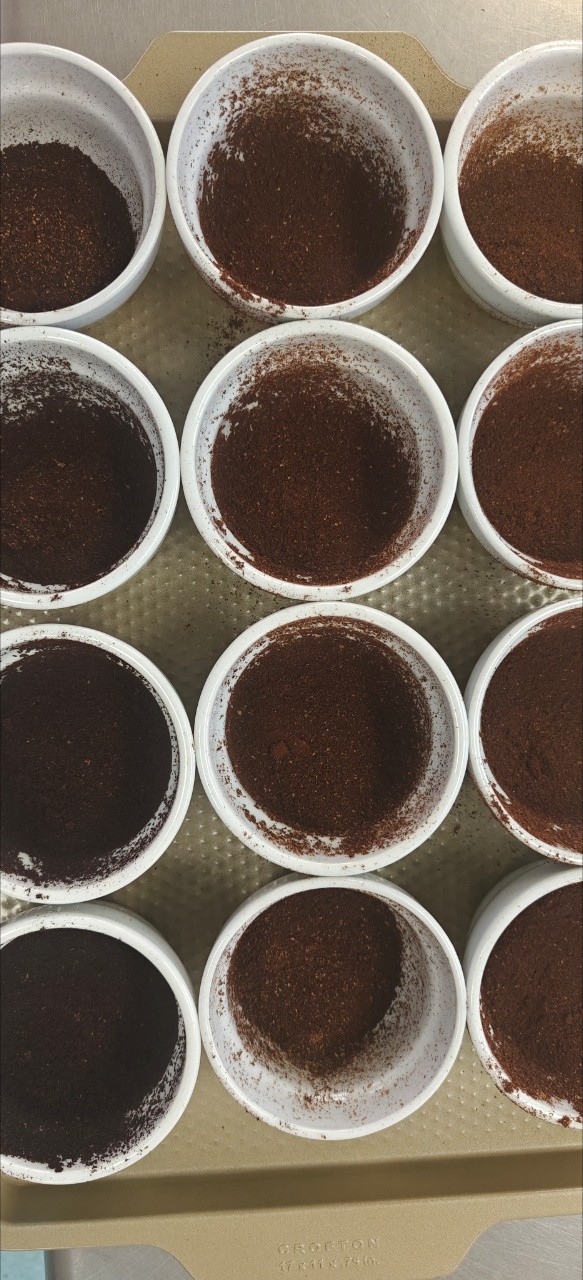
It starts with a fragrance evaluation: smelling the dry coffee grounds. Here I was noticing that around the fifth cup (ordered lightest to darkest) I was getting a good intense fragrance matching my general expectation for this particular coffee.
Then it's time to taste the coffees, lightest to darkest. My favorite on the first sip was cup 2 with some very nice complex fruitiness, but it's not enough for a coffee to only be great on the first sip.
The 2nd tasting goes in the opposite direction: darkest to lightest. Here I started to pick up on the characteristics I'm looking for at cup 7, but 6 was better than 7 and 5 was better than 6. This let me narrow the range of coffees I'm considering to the 2-5 range, all of which for this flight is something that I'd consider a light roast (cup number to darkness isn't fixed between flights. I pull more heavily in whichever regions I most expect to have what I want to get out of that coffee).
From there, I focus on tasting within that range until the coffee is cool and consider whether I want to pick something directly to attempt to replicate on the big roaster or if I think changing how much time I'm spending in key temperature ranges (roast faster or slower) might improve on what I'm tasting. Sometimes I need to go back to the little roaster to try something else, but I'm usually pretty confident that I can make an adjustment if needed and move directly into production testing.
I've been doing this with every coffee I roast for over a quarter century now so I've gotten decently good at reasoning about what I can do to achieve the cup characteristics I want.

After that, hot water is poured over the grounds in the cup and allowed to brew a few minutes. This leaves a crust of coffee grounds floating at the top of the cup which I break with a spoon while moving my nose close to the surface to evaluate the aroma as I break through that crust. Here I found cups 3-7 most interesting. The first cup has some unpleasant attributes and the second cup was just uninteresting. Darker cups weren't bad, but not characteristic of customer expectations.