Neal Wilson ✅ @neal@social.typica.us
- Software
- https://typica.us
- Send Money
- https://typica.us/payment.html
Admin
Author of Typica software for coffee roasters.
Joined Apr 2018
Not sure why anybody would think I'd click a link in a random product advertisement sent as a text message to my phone and buy the product instead of hitting report as spam and block.
Started playing the Dragon Quest 2D HD remakes. Thoughts so far: I am disappointed that the game gave me a ghost instead of a slime as the first enemy (also, why are the slimes now gendered?) and I'm tempted to start over at the highest difficulty since I seem to want to play this more cautiously than normal difficulty warrants (I'm too used to NES Dragon Warrior, I guess). I do like a lot of the quality of life improvements and I adore the orchestral music.
The vast majority of my toll use is going to/from the airport since I'm about the same distance to either Milwaukee or Chicago and it's usually cheaper to fly out of Chicago (I always check both or in cases where the client is buying the flight I advise them to check both and go with whichever is cheaper) so the money in that account lasts a long time.
IL Tollway put a $10 credit on my account as part of replacing the old toll gadget with a sticker
Father's Day doesn't seem to be as good for business as Mother's Day on the day itself, though yesterday was the best sales day of the month at the end of a pretty solid week so maybe all the dads are just having their coffee at home.
There's some overlap with accessibility here. Some of my first users to respond enthusiastically were people who didn't need all the features, but loved that they could make what they did need huge enough for their aging eyes to make out easily.
While it wasn't an intentional design goal, the way Typica lays out roasting data is working very well in a training environment. I have the data on a nicely sized screen well positioned so I can hang back and give the trainee space to work while still being able to see exactly what's going on and call out advice as needed.
While starting with sample roasting does mean that messed up batches waste less coffee, those sample roasts should be getting used in service of high impact purchasing decisions, so mistakes can be a lot more costly unless you're just drilling on things you don't intend use (in which case 100% of the coffee is waste instead of being able to sell the successful batches).
The main problems with starting on sample roasting are down to differences in why you're roasting which impact you roasting needs to be approached and (to an increasingly lesser extent for new installations) substantially worse instrumentation on smaller machines. It means you end up with no experience dealing with 2nd crack at all and learn a lot less on earlier parts of the roast since you're really trying to do everything the same, often without the tools that make this easier.
New roaster training continues today. He's got decent instincts so it's mostly about gaining the experience with different roasting situations and how to approach them and that's happening through doing production roasts. I've never been a fan of the approach of starting new people on sample roasters.
Despite the large difference in flavor profile, I decided that I didn't need to change any of the blend recipes that use the new coffee. Existing recipes were still delicious with the substitution.
New Papua New Guinea is now up for sale on the web site. It should be hitting the shelf locally later today or tomorrow (I need to change the label as the flavor profile is very different from the previous lot). My idea of roasting the coffee faster based on what I was tasting yesterday worked out very well so now I have an Ethiopian coffee that tastes more like a Brazilian coffee and a Papua New Guinea coffee that tastes more like an Ethiopian coffee.
Started training another employee who has expressed interest in doing some coffee roasting. With the wholesale/online business picking up lately it'll be good to have more people who know how to do that so I can start taking vacations again.
The coffee is a natural from Papua New Guinea. Very fruity (blueberry) aroma, not so much in the flavor. I'm going to try roasting it faster to see if I can bring a bit more of that into the cup.
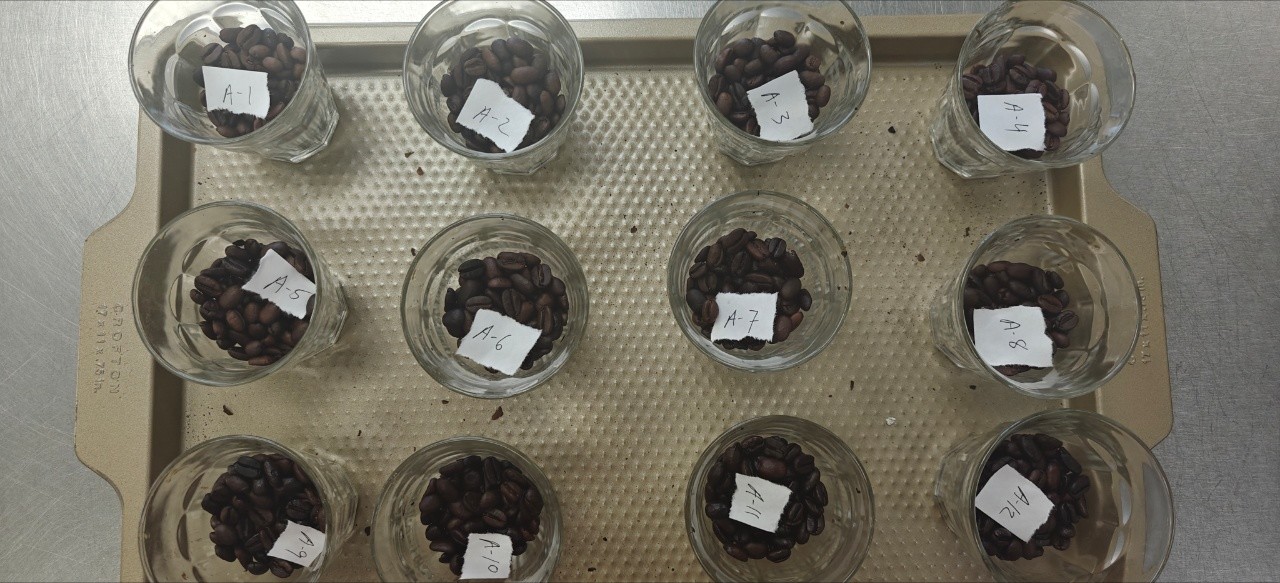
Today's programming has been a continuation of work on the interface for entering green coffee purchase data. This is completely redesigned compared with 1.x and uses a lot less screen space (meaning there's now lots of room for more features). The old UI was a common area of confusion so I'm hoping people find the new one easier to use successfully.
Air conditioning is back on at work. I'm multi-tasking making more chai concentrate with writing software. Later I'll need to fire up the coffee roasters to catch up on production.
The furnace needs a part to get the AC to run properly so I'll be switching over to night roasting until that's fixed. That's going to cause production delays for a few customers.
Work also had power disruptions, but that wasn't too bad. Coffee roaster was mostly cooled off with nothing in the roasting chamber. I was trying to use a scale that really doesn't like unexpected power outages and power kept going out briefly before the scale recovered from the previous outage.
There's weather happening. Power company says my house doesn't have power so I'll have to decide if I want to try to find some take out or if I'm going to risk dinner being saltines and cheesecake. Maybe they'll let me know that power is on before I'm done with work and I can just cook a proper dinner.
- Software
- https://typica.us
- Send Money
- https://typica.us/payment.html
Admin
Author of Typica software for coffee roasters.
Joined Apr 2018