Neal Wilson ✅ @neal@social.typica.us
- Software
- https://typica.us
- Send Money
- https://typica.us/payment.html
Admin
Author of Typica software for coffee roasters.
Joined Apr 2018
I've been doing this with every coffee I roast for over a quarter century now so I've gotten decently good at reasoning about what I can do to achieve the cup characteristics I want.
From there, I focus on tasting within that range until the coffee is cool and consider whether I want to pick something directly to attempt to replicate on the big roaster or if I think changing how much time I'm spending in key temperature ranges (roast faster or slower) might improve on what I'm tasting. Sometimes I need to go back to the little roaster to try something else, but I'm usually pretty confident that I can make an adjustment if needed and move directly into production testing.
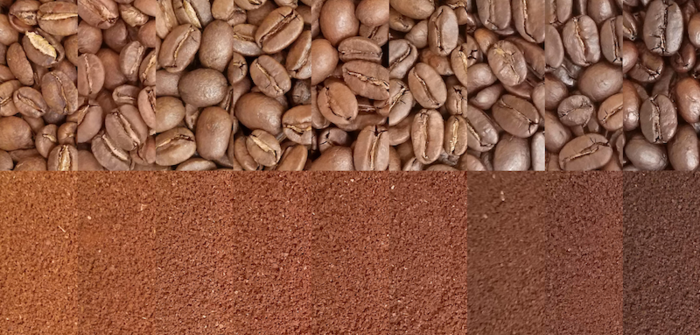
The 2nd tasting goes in the opposite direction: darkest to lightest. Here I started to pick up on the characteristics I'm looking for at cup 7, but 6 was better than 7 and 5 was better than 6. This let me narrow the range of coffees I'm considering to the 2-5 range, all of which for this flight is something that I'd consider a light roast (cup number to darkness isn't fixed between flights. I pull more heavily in whichever regions I most expect to have what I want to get out of that coffee).
Then it's time to taste the coffees, lightest to darkest. My favorite on the first sip was cup 2 with some very nice complex fruitiness, but it's not enough for a coffee to only be great on the first sip.
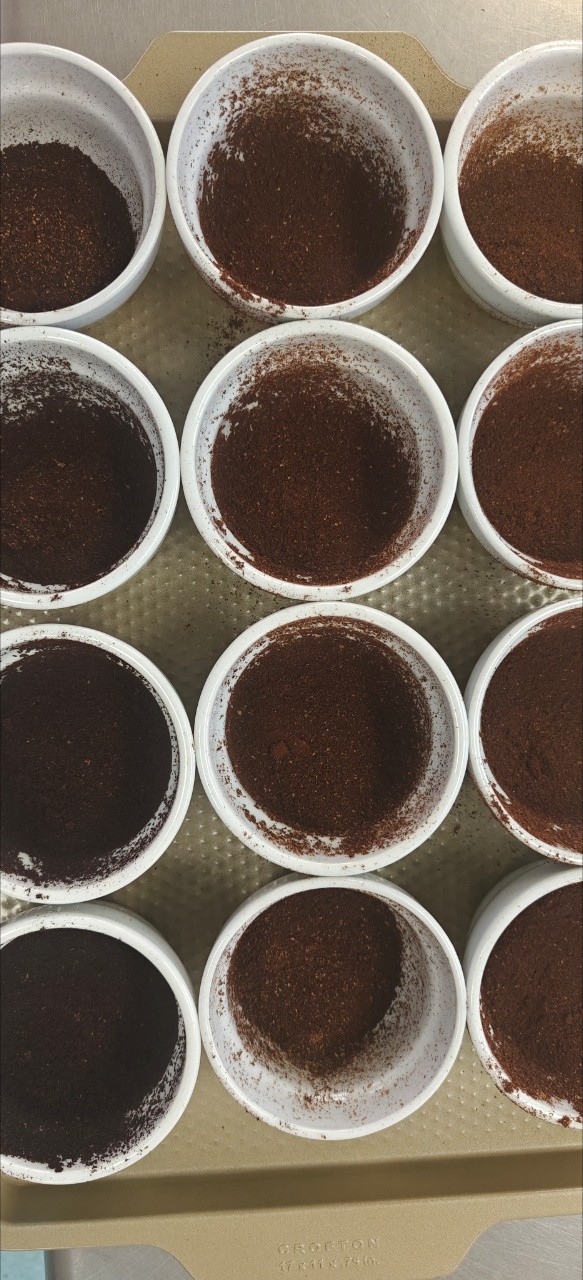
After that, hot water is poured over the grounds in the cup and allowed to brew a few minutes. This leaves a crust of coffee grounds floating at the top of the cup which I break with a spoon while moving my nose close to the surface to evaluate the aroma as I break through that crust. Here I found cups 3-7 most interesting. The first cup has some unpleasant attributes and the second cup was just uninteresting. Darker cups weren't bad, but not characteristic of customer expectations.
It starts with a fragrance evaluation: smelling the dry coffee grounds. Here I was noticing that around the fifth cup (ordered lightest to darkest) I was getting a good intense fragrance matching my general expectation for this particular coffee.
When I have a tray of coffees like this, there's a specific process I'm using to decide how I would like to try roasting the coffee first for a production test batch and then generally for sale.
The dish soap section in the grocery store was somewhat baffling. They had bottles marked with a line encouraging you to refill next to bigger "refill size" bottles, but calculating the per unit volume price, the refill bottle was significantly more expensive. If the calculation went the other way, I also didn't see any reason I wouldn't be able to just use the soap directly out of the bigger bottle instead of trying to pour it from one bottle into another.
Lots of cars with collectors plates on the road during my after work errand running. They looked cool, but it looked and sounded like most of them had no clue how to properly drive the things. I feel a little sorry for the other drivers who were closer to them on the road and hope none of them got into a road rage.
Had some thoughts while roasting and I think I need to spend some time playing with maths to explore those ideas and see if the might be useful to implement.
Both of my work from home days this week had me at the shop for a little bit. Yesterday to unload a truck, today to take care of an order. Still got a little software dev time in, though, and the roasting lets me confirm that today's changes work properly.
Last night's code changes were a huge improvement to user joy.
Neal Wilson ✅
boosted

Quote from an AliExpress product description:
"We cannot solve all problems for you but we will provide some."
🙃
Gathered more observations on a minor bug that's annoying me. I probably need to rethink the whole algorithm involved, but I'll look at that later.
Today's coding was a bunch of small and quick QoL improvements. I've got a few larger ones that I want to take care of as well, but I don't think I want to work on any of those until after dinner.
Oh no, it's worse. This was a chocolate company. Come on, Valentines Day is right there.
Dear corporate America, please stop trying to make Black Friday in February a thing. Come up with something else.
Did a small coffee order (a little over $3000) for things that are expected to get to a nearby warehouse tomorrow. I'll need a bigger order later, but most of what I'm looking at isn't getting into the country until March or maybe late February. I'll have to reallocate some of the coffee I already have to different products in the meantime.
Related, if you're making the wrong assumption that email is instantaneous and a short expiration time is acceptable, give people an easy way to have a fresh code re-sent when the first code that goes out expires before it's received instead of being all, "well, I guess we don't really want your $800 order".
- Software
- https://typica.us
- Send Money
- https://typica.us/payment.html
Admin
Author of Typica software for coffee roasters.
Joined Apr 2018